Senator Godswill Akpabio: 63 Years Of Enduring Impact
By Eseme Eyiboh
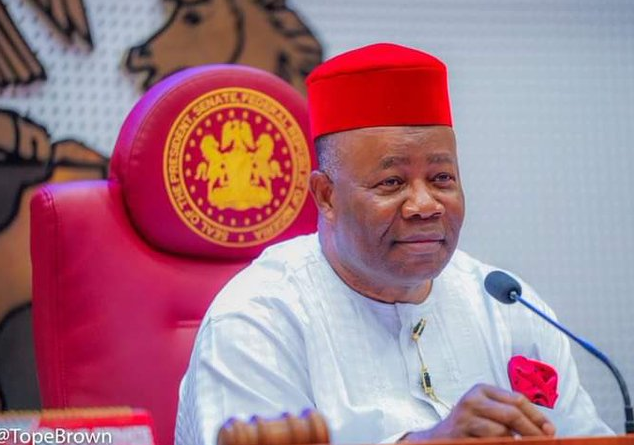
On this ninth day of December, in the year 2025, as the nation stirs to its familiar rhythm, a man stands quietly at the crossroads of personal milestone and public memory. Senator Godswill Obot Akpabio, GCON, marks his 63rd year on earth—another turn on the wheel of time for a figure whose shadow has long stretched across the public life of Nigeria.
He was born in Ukana Ikot Ntuen, Essien Udim—one of those villages where the future rarely announces itself with trumpets, but where the soil has a way of preparing men for the long, hard disciplines of service. His childhood was shaped by the steady lessons of Methodist Primary School, the formative rigour of the Federal Government College, Port Harcourt, and later the University of Calabar, where he earned a law degree that would become less a credential than a compass.
Before politics found him—or before he found politics—Akpabio walked several honest roads: teacher, lawyer, partner, corporate executive. These were not glamorous roles, but they were instructive. They taught him something about the dignity of work, the stubbornness of hope, and the slow grind through which a man discovers his convictions.
Then came public office—a chapter not whispered into existence, but written in the bold script of infrastructure, reform, and unyielding ambition. As Governor of Akwa Ibom State from 2007 to 2015, he presided over the kind of transformation that does not happen quietly. Roads carved through old terrains; bridges defeated rivers long thought unconquerable; an airport rose from the red earth; a stadium stood like a declaration that the people had reclaimed their sense of possibility. And in classrooms and hospitals, thousands felt the soft but decisive undertones of free education and accessible healthcare. They called him “The Uncommon Transformer,” not because the phrase was fashionable, but because it was true.
His path then led to the 9th Senate of the Federal Republic, where he got swift the recognition of his peers in the main opposition Peoples Democratic Party (PDP), who made him the Minority Leader of the Senate. Characteristic of Akpabio – whose name has come to connote excellence – he played the role admirably until the need for a better deal for his constituents made him to defect to the ruling All Progressives Congress (APC).
Akpabio was to take a break from the Senate following his appointment as a Minister of Niger Delta Affairs, where he confronted a region often defined by contradiction—rich in resources, poor in infrastructure; blessed with talent, burdened by history. And yet, under his watch, a symbol of bureaucratic paralysis finally gave way: the long-delayed NDDC Headquarters was completed and inaugurated, its doors swinging open after nearly two decades of excuses.
Back in the Senate and now as President of the 10th Senate, Akpabio’s leadership is marked by something rarer than rhetoric: steadiness. The kind of steadiness that can hold a chamber together in times of partisan whirlwinds; that can encourage cooperation with the Executive without surrendering oversight; that can restore a sense of rhythm to national budgeting after years of drift. In just two years, the Senate under his watch has moved decisively—reforming education laws, modernizing taxation, strengthening regional development, and pushing for genuine autonomy for local governments.
Twice, his colleagues have risen—unprovoked—to pass a vote of confidence in him. In politics, such gestures are not born of sentiment; they are earned by the invisible arithmetic of trust.
On the global stage, he achieved what had eluded Nigeria for six decades: a seat on the Executive Committee of the Inter-Parliamentary Union. It was more than an election; it was a restoration of presence, a reminder that nations are not only heard when they speak loudly, but when they speak with clarity and purpose.
The honours that have followed him—from “Best Governor in Africa” to “Man of the Year,” from national decorations to continental recognition—are footnotes, not the story. The story is simpler, older, and more enduring: a man who has spent much of his life in the public square, pushing institutions toward competence, and people toward hope.
And so, on this 63rd birthday, the occasion invites not celebration but reflection—reflection on a life that suggests that public office, when handled with vigour and imagination, can still be a noble calling. It is also an invitation to look forward. For the work of nation-building is never finished, and the ideals that have guided Senator Godswill Akpabio—unity, inclusiveness, good governance, and development—remain as necessary today as when he first stepped into the arena.
As Edward R. Murrow would say, “This is not the end of the story. Only another nightfall on the long road of a man still in service to his country”.
•Rt. Hon. Eseme Eyiboh is Special Adviser, Media / Publicity & Official Spokesperson for The President of The Senate.