Oyebanji’s Magic Wand In Ekiti…By Bolanle BOLAWOLE
“Interestingly, all three governors, including Niyi Adebayo (governor of the state between 1999 and 2003) graced the occasion, despite their different political persuasions. The photograph of all four former governors sitting together at the event registered in my mind. How Oyebanji has been able to criss-cross Ekiti’s volatile political cleavages to build bridges and construct consensus beats the imagination of many”
turnpot@gmail.com 0705 263 1058
It has been quite a while since I travelled in Ekiti state. I used to, on a weekly basis, between 2016 and 2018 when the then governor of the state, Peter Ayodele Fayose, extended an invitation to me. Taking off from Lagos (when the Lagos-Ibadan expressway was still a nightmare) and braving the more decrepit Ibadan – Ife – Ilesa road before branching off the Ilesa-Akure expressway into Itawure, every trip to and fro Ekiti was a huge sacrifice.
Ekiti roads were notorious for their sharp bends, twists and turns. The many hills (Okiti, in Yoruba) gave the state its name. One spectacle a traveller cannot miss is the avalanche of farm produce wasting away along the winding Itawure, Erin, Efon-Alaye, up through Aramoko, Igede, Iyin and Ado-Ekiti road. The same spectacle assaults you if you detour off the Ife-Ilesa-Akure road at Igbara into Ado- Ekiti, driving through Femi Falana’s Ilawe-Ekiti.
Mountains of all manner of farm produce rot away by the roadside. Oranges, pawpaws, plantains and bananas, mangoes (during their season), pineapples, name it. It is debatable if the farmers get anything more than a fraction of what they actually should have reaped from their efforts.
The reason is simply because Nigeria, once it joined the league of oil-producing nations, abandoned agriculture, which used to be the mainstay of its economy. The First Republic government of Chief Obafemi Awolowo, which remains the golden age of the Western Region because of its achievements, relied heavily on agriculture. Not any more, for its successor-states have been reduced to begging bowls (to quote my sister, Funke Egbemode’s coinage) that throng Abuja every month to receive dole-outs from the Federation Account, like the other states of the Federation.
The neglect of agriculture, the mainstay of the economy of our largely rural and agrarian populace, is the main reason for the massive poverty that has enveloped the once agriculture-rich South-west region. Until we return to the soil – to agriculture and responsible mining of the mineral resources that the region is endowed with – any talk about taking the people out of poverty will remain a mirage.
I said “responsible mining” because any arrangement whereby the people are not the owners of the enterprise but are mere onlookers as scavenging capitalists cart away their God-endowed resources in a brutal manner while destroying the environment (as has been the case in the Niger Delta region), will only leave the communities concerned the worse for it.
For anyone who lives in Lagos, Ekiti may be a far-away destination. Take a trip, then, to the Ketu fruits market and marvel at the quantity of farm produce that is lost everyday to lack of good storage and transportation facilities! Lorry-loads of oranges, pawpaws, mangoes, plantains, bananas, pineapples arrive with a huge percentage of it already wasted! Yet, the owners must cover costs and also make profit.
So the cost of what is lost is spread on top of what eventually makes it to the market. That is one reason why the cost of such items become prohibitive. This goes on day-in, day-out; the authorities do not appear to give a hoot. Farmers and marketers themselves appear helpless. The farmers must have resigned themselves to their fate. The marketers must have found an ingenious way of passing the buck to buyers. Hapless buyers themselves look elsewhere to make their own cut so as to make ends meet. It is a vicious cycle that leaves everyone in a lose-lose situation.
When the Ekiti state agro-allied international cargo airport reportedly roared to life last week, I not only heaved a sigh of relief, I was equally elated. For one, the promise has been that the airport would help address the needless wastage of Ekiti agricultural produce. For another, the airport project had been the butt of cruel jokes, having been mired in one controversy after another.
After gulping what is said to be close to a staggering N50 billion, it would have been a monumental disaster if that quantum of money went down the drain. Now, finally, finally, the government of BAO (Biodun Abayomi Oyebanji) has delivered on the airport project.
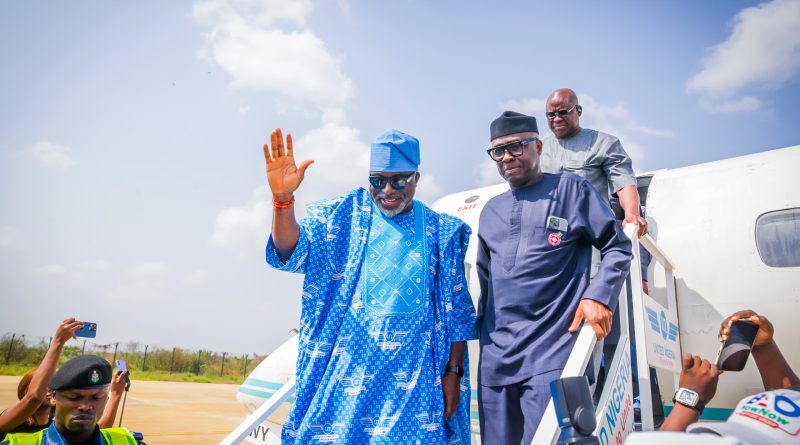
An edited version of a report on the airport project goes something like this: “History was made in Ekiti on Wednesday as Gov. Biodun Oyebanji led other dignitaries to receive the first commercial flight at the Ekiti Agro-Allied International Cargo Airport in Ado Ekiti, describing the project as a major milestone in the state’s quest for economic growth and enhanced connectivity. The United Nigeria aircraft with registration number 5N-BWY with about 50 passengers on board arrived (at) the airport at about 11:09 am and departed at 12.00 noon for Lagos.
“Dignitaries on board include Senate Leader, Senator Opeyemi Bamidele; three former governors of the State – Dr. Kayode Fayemi, Otunba Niyi Adebayo, and Dr. Ayodele Fayose. Also on board were members of the National Assembly from Ekiti State; Chairman of United Nigeria Airline, Prof. Obiora Okonkwo; Permanent Secretary, Ministry of Aviation and Aerospace Development, Dr. Yakubu Adam; and a former minister of Aviation, Mr. Babatola, among others.” Maybe they mean Babatunde Omotoba (who was the Minister of Aviation between 2008 and 2010).
The story continues: ”They were received by Gov. Oyebanji; his wife, Dr. Olayemi Oyebanji; the deputy governor, Chief (Mrs.) Monisade Afuye; former Gov. Segun Oni; Technical Advisor on Airport Project, AVM Sunday Makinde (rtd.); and other state officials.“
Speaking during the historic event, Oyebanji, who disclosed that over N49 billion was expended on the project, noted that the investment reflected the state government’s commitment to critical infrastructure that would stimulate development, attract investors and create jobs for the people of the state (adding that) the airport was strategically designed to support the export of agro-produce, boost value chains and reduce post-harvest loss for farmers”.
Oyebanji was also quoted as having said that the airport would open Ekiti to global opportunities, particularly in agriculture, commerce and tourism. “Commending his predecessors for their efforts at birthing the airport, particularly Gov. Kayode Fayemi who laid the foundation and took the project to a substantial level, Oyebanji said the completion of the project underscored the gains of continuity in governance.”
The governor was also quoted as commending members of the National Assembly from Ekiti state, President Bola Ahmed Tinubu “whose economic reforms freed resources to sub-national (governments) and made such projects possible for the development of the state”, Chief Afe Babalola (SAN) “for his selflessness, generosity and unflinching support to the airport project (and for) the donation of navigational aids (CVOR/DME) and control tower equipment worth $1.6 million and the construction of 100-car capacity car park at the cost of N356 million”.
Rather than usurp total credit for the airport project, as some other governors in his shoes would have done, Oyebanji chose to share the podium with his predecessors when he said: “The making of this airport is a collective legacy of at least three Governors before me – Engineer Segun Oni, who first conceived the idea, Governor Ayo Fayose, who acquired and initially cleared the site; and Dr. Kayode Fayemi, who, despite all odds, braved the wind of challenges to commence the building of the airport six years ago. Today’s event is, therefore, an applause to our collective determination.”
Interestingly, all three governors, including Niyi Adebayo (governor of the state between 1999 and 2003) graced the occasion, despite their different political persuasions. The photograph of all four former governors sitting together at the event registered in my mind. How Oyebanji has been able to criss-cross Ekiti’s volatile political cleavages to build bridges and construct consensus beats the imagination of many.
I therefore went to town to ask questions from those versed in Ekiti politics. One respondent said: “I think it’s more about building a political dynasty. APC governor Fayemi secured the go-ahead for the project under a federal APC government. Fayemi handed over to another APC government of BAO under an APC federal government. Political patronage! Let me ask you about all those proliferating airports in states: How many will be economically viable in the next 20 years? Ibadan airport that was recently upgraded to international status will have MMIA in Lagos to contend with. I wait for what the international traffic will look like in the next couple of years.”
Another commentator said: “All (the former governors) contributed to the airport project. I am aware the vision took roots during the tenure of Hon. Omotoba, a native of Iyin-Ekiti. It was embraced by the government of Chief Segun Oni. Every successive administration since then has played a supportive role till the eventual commissioning. There were also contributions from individuals, including the respected Aare Afe Babalola, SAN, founder of Afe Babalola University, a neighbouring institution to the airport, who funded some critical facilities of the airport. The presence of the past governors is significant as it is a continuation of the engaging skill of the incumbent Gov. Oyebanji, which is widely acknowledged by all. The warmth with which the past governors have continuously reciprocated BAO’s friendly approach since coming into office is further demonstrated by their full participation in the historic premiere commercial flight to the airport. It is also no doubt an ‘Omoluabi’ ethos which places the collective interest of Ekiti people above individual preferences of partisan political tendencies.”
Yet another commentator has this to say: “Actually, I see nothing extraordinary about it. The occasion is for the greater good of Ekiti state. And if you dig deeper, and I know this for a truism, all of them are friends – apart from being political colleagues. We should not read meanings to this gathering of people who had worked together in various spheres of life, including sharing the same political platforms at one point of their life.”
Scripture says “In the multitude of counsel there is safety” (Proverbs 11:14). The first commentator harps on continuity. Abandonment of projects, lack of maintenance culture, and continuity blues have been the bane of many laudable projects in this country. Thank God the Ekiti agro-allied international cargo airport project was not abandoned as critics have feared. The task before Oyebanji and successive Ekiti governors is how to nurture it to maturity.
Governance is a continuity, especially when projects are carefully considered and painstakingly implemented for their relevance and contribution to development and growth. And if Ekiti, in the laudable example of Aare Afe Babalola tells us anything, it is that the task is not the government’s alone. Public-spirited individuals also have a role to play. A man’s real worth does not consist of the quantum of money starched away in bank vaults but in the positive contributions made to the society in which we live.
It may be true that the Ekiti former governors have been friends-cum-political allies at one point or the other, but so also have been the trio of Gbenga Daniel, Ibikunle Amosun, and Dapo Abiodun in Ogun state! Why are they cooperating and complementing in Ekiti for the betterment of their people while they are fighting silly in Ogun state?
Former editor public affairs of PUNCH newspapers, Chairman of its Editorial Board and Deputy Editor-in-chief, BOLAWOLE was also the Managing Director/Editor-in-chief of The Westerner news magazine. He writes the ON THE LORD’S DAY column in the Sunday Tribune and TREASURES column in New Telegraph newspaper on Wednesdays. He is also a public affairs analyst on radio and television.