
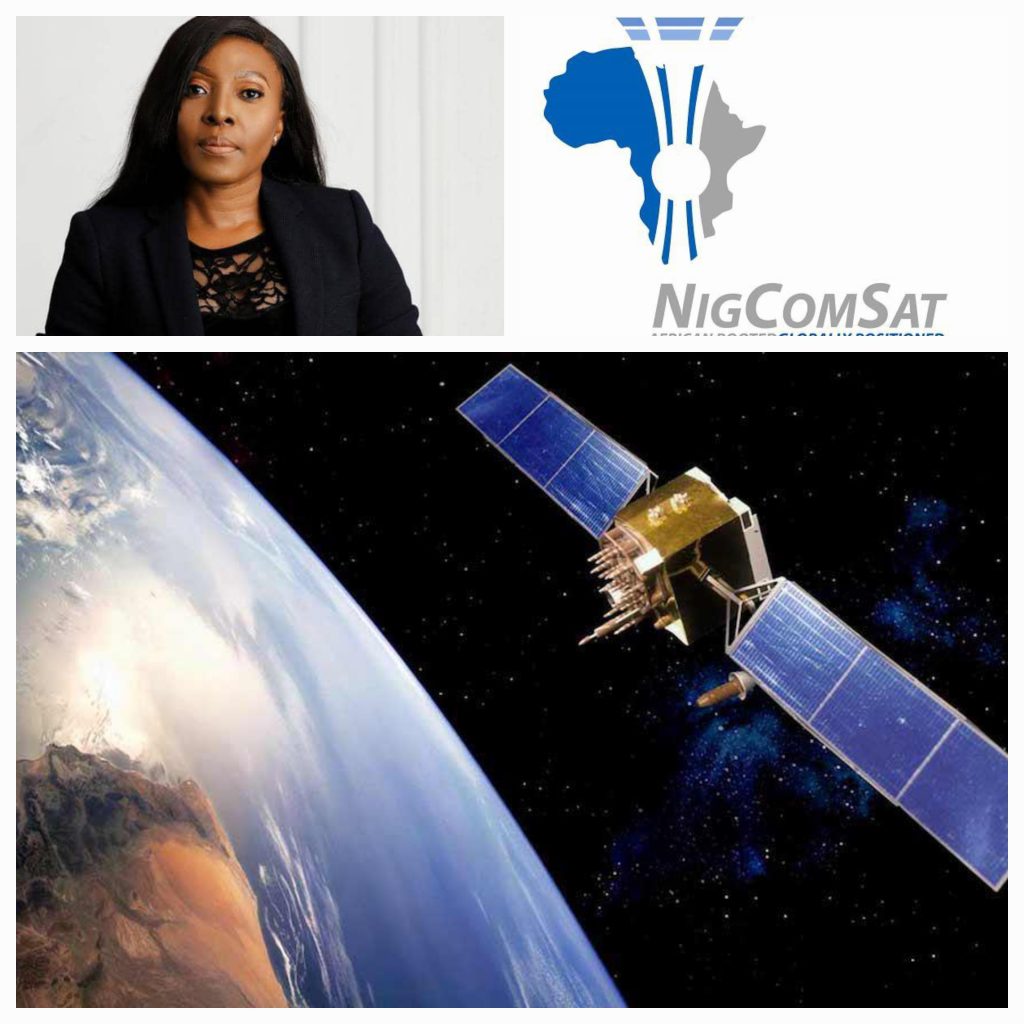
The Satellite That Refused To Stand Still: Why Nigeria’s Space Asset Is Finally Coming Into Its Own
By Danjuma Amodu
For more than a decade, Nigeria has occupied a unique but under-celebrated position in Africa’s digital story. Since 2011, the country has operated its own communications satellite—an achievement few nations on the continent can claim. It placed Nigeria in a select league of countries with sovereign space-based communications infrastructure, a strategic asset capable of shaping everything from national security to broadband access. Yet for years, that satellite seemed to orbit in quiet contradiction: full of promise, but only partially woven into the fabric of everyday Nigerian life.
That contradiction is now being challenged.
When Jane Nkechi Egerton-Idehen assumed leadership of Nigerian Communications Satellite Limited in 2023, she stepped into an institution that reflected a broader pattern in Nigeria’s public infrastructure—significant capital investment without corresponding utilisation. The satellite’s broadcasting capacity was underused, its broadband services had lost commercial traction, and the organisation leaned heavily on government patronage. In a country where millions remained unconnected, the gap between capability and impact was glaring.
Her arrival coincided with a policy shift under President Bola Ahmed Tinubu, whose Renewed Hope Agenda placed digital infrastructure at the centre of economic transformation. That alignment of leadership and national policy created a narrow but critical window: the chance to reposition satellite technology not as a technical luxury, but as foundational infrastructure.
To understand the significance of what has followed, it is important to situate Nigeria’s satellite programme within a broader historical and economic context. Nigeria’s space ambitions date back to the early 2000s, driven by a recognition that terrestrial infrastructure alone could not solve the country’s connectivity challenges. Vast rural expanses, difficult terrain, and the high cost of fibre deployment meant that millions would remain excluded unless alternative technologies were deployed. Satellite offered that alternative—capable of reaching the unreached, connecting the disconnected, and doing so at scale.
But infrastructure, by itself, does not guarantee impact. It requires strategy, partnerships, and, crucially, a market.
What has changed in the past two years is not the satellite itself, but how it is being positioned. Under Egerton-Idehen’s leadership, NIGCOMSAT has shifted from a largely government-facing agency to a more commercially aware and partnership-driven enterprise. The expansion of television channels on its platform—from 45 to 150—and the growth of its audience from 2 million to 7 million Nigerians are not just statistics; they represent a deliberate effort to maximise existing capacity and prove relevance in a competitive media landscape.
Equally important is the organisation’s role in Nigeria’s Digital Switch Over, executed in partnership with the National Broadcasting Commission. For years, the transition from analogue to digital broadcasting has been slow and uneven. Satellite infrastructure, with its wide coverage and reliability, provides the backbone needed to accelerate that transition. In this sense, NIGCOMSAT is not merely a participant but an enabler of a long-delayed national reform.
Perhaps the most consequential shift, however, lies in connectivity. Nigeria’s digital divide is not just a technological issue; it is an economic and social fault line. Urban centres continue to attract investment in fibre and mobile networks, while rural communities remain underserved because the business case for traditional infrastructure is weak. By partnering with companies such as MTN Nigeria and IHS Towers, NIGCOMSAT is positioning satellite as a complementary layer—extending coverage to places where cables cannot easily go.
This has real-world implications. It means a rural clinic can access telemedicine services. It means a school in a remote community can connect to digital learning platforms. It means security agencies, including the Nigerian Navy, can maintain communication in environments where terrestrial networks fail. These are not abstract gains; they are practical interventions in some of Nigeria’s most persistent development challenges.
The introduction of the NIGCOMSAT Accelerator Programme in 2024 adds another dimension to this transformation. Historically, space infrastructure in many countries has been treated as a closed system—owned and operated by government, with limited avenues for private sector innovation. By opening access to startups, NIGCOMSAT is effectively democratising its infrastructure, allowing entrepreneurs to build solutions on top of it.
The significance of this cannot be overstated. More than 80 startups have already passed through the programme, developing applications that range from security-focused drone systems to healthcare connectivity platforms. The example of rural hospitals being linked through VSAT technology illustrates a broader point: when infrastructure becomes accessible, innovation follows. By training over 500 young Nigerians—many of them women—the programme is also investing in human capital, ensuring that the country is not just a consumer of technology, but a creator.
At the policy level, voices like Bosun Tijani have reinforced the strategic importance of satellite technology. His assertion that satellite systems sit at the centre of global digital transformation reflects a growing consensus: connectivity is no longer optional; it is foundational. In this context, Nigeria’s status as the only West African country with its own communications satellite is not just a point of pride—it is a strategic advantage that must be fully leveraged.
That advantage is set to deepen with the planned launch of NigComSat-2A and NigComSat-2B, approved by the federal government and scheduled for 2028 and 2029. These satellites will expand capacity, improve redundancy, and position Nigeria to meet growing demand for broadband and digital services. More importantly, they signal continuity—a recognition that space infrastructure is not a one-off investment, but a long-term commitment.
Yet, even as progress is evident, it would be premature to declare victory. Challenges remain. The sustainability of commercial gains, competition from global satellite providers, regulatory bottlenecks, and the broader economic environment will all shape the trajectory of NIGCOMSAT’s transformation. The real test will be whether these early gains can be consolidated into a durable, self-sustaining model that continues to deliver value beyond government support.
Still, there is a clear shift underway. For years, Nigeria’s satellite story was one of quiet existence—present, functional, but largely peripheral to the national conversation. Today, it is becoming central to discussions about connectivity, innovation, and economic inclusion.
Egerton-Idehen captured this vision succinctly when she framed investment in space as an investment in education, healthcare, security, and commerce. That framing matters because it reframes the narrative: from space as a distant, technical domain to space as a practical tool for development.
In the end, the story of Nigeria’s satellite is not just about technology. It is about utilisation, leadership, and the ability to translate infrastructure into impact. After years of circling with untapped potential, the satellite that once seemed content to stand still is now moving—steadily, deliberately—into the centre of Nigeria’s development agenda.
Danjuma Amodu is a journalist and public analyst based in Abuja. He writes on governance, digital infrastructure, and public policy.