
MCE To Tinubu:Deploy Technology To Fight Terrorism …Says “We’ll Ensure 2027 Election Is Free And Fair”
The Movement for Credible Elections (MCE) has called on President Bola Tinubu to deploy technology to fight against terrorism that is threatening to make the country ungovernable.
The group also advised the National Assembly to undertake further amendments to the Electoral Act to strengthen the electoral process and enable the Independent National Electoral Commission (INEC) to conduct credible elections ahead of the 2027 general polls.
MCE also hinted that it would set up a Think Tank to ensure that the 2027 general election is free and fair.
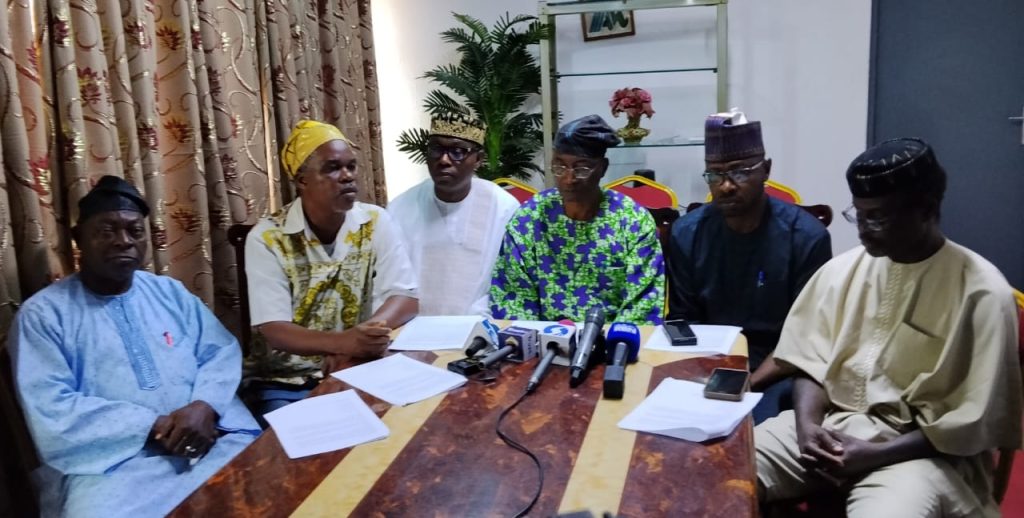
Speaking at a news conference in Lagos on Saturday on the future of democracy in Nigeria, the group unveiled what it described as an “Agenda for a Credible Nigeria,” urging the government to prioritize electoral integrity, prudent management of national resources, security, agricultural development, and constitutional reforms.
Leader of the movement, Dr. Tunji Abayomi, said the primary responsibility of government should be to guarantee free, fair and credible elections, stressing that democracy can only thrive when citizens are allowed to freely choose their leaders.
According to him, the focus of government should go beyond winning elections and concentrate on protecting the sovereignty of the people through transparent electoral processes.
“We hold the view that if government establishes free and fair elections and loses through that process, the government has still won because the people of Nigeria have won,” Abayomi said.
He noted that for many ordinary Nigerians, the right to elect leaders remains their most valuable democratic asset and should be protected at all costs.
“The first commitment of government should be to ensure that Nigerians freely exercise their right to choose those who govern them. Once that right is undermined, the foundation of democracy is weakened,” he added.
The group also expressed dissatisfaction with what it described as the disproportionate allocation of public funds to the running of government compared to investments in critical sectors such as healthcare, education, water supply, food security and social welfare.
Abayomi argued that national wealth belongs to the people and should primarily be deployed to improve their living conditions rather than sustain the machinery of government.
“We are concerned about the huge resources devoted to maintaining government while essential sectors that directly affect the lives of citizens receive inadequate funding. There is a need for greater accountability and a people-centred approach to resource management,” he said.
On insecurity, the movement described terrorism, banditry and other violent crimes as serious threats to national stability, calling for a more technology-driven approach to security management.
According to the group, traditional methods of combating criminal activities are no longer sufficient in the face of evolving security challenges.
“The world has changed. Technology has become the modern standard for combating insecurity. Government must invest significantly in advanced security technologies and collaborate with international partners where necessary to protect lives and property,” Abayomi stated.
He warned that continued insecurity was undermining agricultural production, restricting movement and threatening food security across the country.
The movement further highlighted the growing challenge of food insecurity and declining agricultural productivity, urging government at all levels to take decisive action to support farmers and boost food production.
It warned that rising poverty and hunger among citizens could worsen if urgent measures were not taken to address threats facing the agricultural sector.
“Nigeria has enormous agricultural potential, yet millions of citizens are struggling with hunger. Government must move beyond assurances and implement concrete policies that will improve food production and guarantee food security,” the group said.
MCE also renewed calls for the adoption of a people-driven constitution, arguing that the 1999 Constitution lacked the legitimacy of broad public participation because it was enacted under military rule.
The group maintained that a truly democratic constitution must emerge from a process driven by the Nigerian people and reflect their collective aspirations.
“We believe that a constitution made by the people, for the people and through the people has become imperative if Nigeria is to achieve lasting peace, order and good governance,” Abayomi said.
As part of its resolutions, the movement announced plans to establish an ideological think tank comprising pro-democracy advocates, journalists and other stakeholders to mobilise support for reforms aimed at strengthening democracy and addressing the country’s socio-political challenges.
The group said the initiative would focus on promoting national development, democratic values and citizen participation in governance.
Other signatories to the resolutions include former Minister of Sports, Comrade Solomon Dalung; Dr. Tanko Yunusa; veteran activist Olawale Okuniyi; Prince Wole Adebayo; Professor Sadiq Umar; Professor Shonaya; Emeka Ugo Oju; and Comrade Olusegun Mayegun, among others.