Gates Foundation Pushes AI For National Development, Urges Nigerian Innovators To Solve Real Problems
By Bukar BOLORI
The Gates Foundation has challenged Nigerian innovators to channel artificial intelligence (AI) toward addressing pressing development problems, insisting that the value of the technology lies not in its sophistication but in its ability to improve lives and accelerate national development.
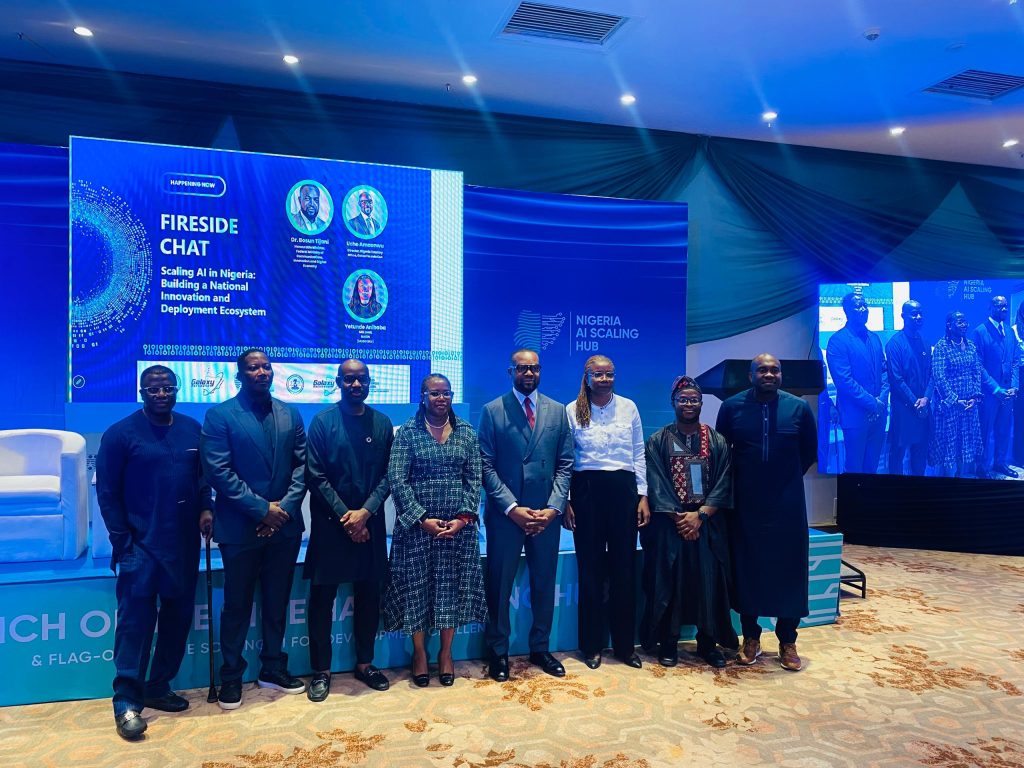
The call was made at the launch of the Scaling AI for Development (SAID) Challenge under the Nigeria AI Scaling Hub (NAISH), a collaborative initiative involving the Federal Ministry of Communications, Innovation and Digital Economy, the Gates Foundation, and Lagos Business School.
The initiative seeks to move Nigeria’s AI ecosystem beyond experimentation and isolated pilot projects to large-scale deployment by linking proven innovations with government institutions and public-sector agencies.
Speaking at the launch, Country Director of the Gates Foundation Nigeria Country Office, Uche Amaonwu, urged innovators to become creators of locally relevant solutions rather than mere consumers of technologies developed elsewhere.
“Don’t be passive adopters of technology developed elsewhere. We need builders of solutions that reflect local realities and can shape how responsible AI should work in contexts like Nigeria and across the Global South, where the challenges are very different and where the needs are urgent, real and deeply human in nature. This is how we ensure innovation becomes truly transformative,” he said.
Amaonwu stressed that the foundation’s approach to AI is rooted in development outcomes and improving living conditions, particularly in developing countries.
“Can we start thinking about AI as a way to achieve national development? We have real challenges that we are facing, whether it is the farmer trying to tackle climate volatility or the health worker trying to do a lot with little. For us, AI is not about the glamour of technology. It is simply whether it can help us do things that improve outcomes for people where the need is greatest,” he said.
The SAID Challenge focuses on scaling tested AI solutions in priority sectors including healthcare, agriculture, education, financial services and public administration.
It is designed to create a structured pathway for deploying innovations that have already demonstrated success in pilot programmes and can deliver measurable improvements in service delivery and development outcomes.
Minister of Communications, Innovation and Digital Economy, Dr. Bosun Tijani, said artificial intelligence has become central to the future competitiveness and economic development of nations and that Nigeria cannot afford to lag behind.
According to him, the true measure of success will be determined by whether AI can improve productivity, expand access to services and create opportunities for citizens.
“From the beginning, we understood that artificial intelligence will shape the future of competitiveness of nations. The real measure of success will not be in how many strategies we write or partnerships we announce, but whether AI helps a farmer increase productivity, whether it helps a teacher reach more learners, or whether it supports better healthcare, stronger businesses and greater opportunities for people,” he said.
He added that the Nigeria AI Scaling Hub was established to move innovation from policy documents into everyday use and ensure that technological advances translate into improved livelihoods and stronger institutions.
Tijani, however, warned that many promising Nigerian innovations fail to achieve national impact because they are constrained by inadequate infrastructure and limited access to finance and support systems.
He also emphasised the need for broad-based partnerships involving researchers, innovators, policymakers and development partners, arguing that no single stakeholder can drive technological transformation alone.
“If we continue to work in isolation, we will not scale, but when we work together with clarity and consistency, we move the country forward. This alignment is what turns vision into national progress,” he said.
The minister further argued that artificial intelligence must be deployed to confront inequality and address the daily realities of vulnerable populations.
“There are many Nigerians who cannot read or write, and imagine them at a police station trying to give a report. These are the people who experience the system most. When farmers lose markets to countries like Brazil and Argentina, that is what poverty looks like in reality.
“When people say AI is not about poverty, let them understand that without these tools, we cannot solve poverty or inequality. AI must directly confront these lived realities to be meaningful,” he added.
Also speaking, Use Case Acceleration Lead at the Nigeria AI Scaling Hub, Lagos Business School, Oreoluwa Olaitan, said Nigeria’s major challenge is not a shortage of AI talent or innovative ideas but the absence of mechanisms that connect solutions with institutions and the people who need them.
“Nigeria does not have a shortage of AI solutions. We do not have a shortage of AI talent. What we’re short of is the bridge that connects the solutions to the people that need them. Without this bridge, even strong innovations remain disconnected from impact,” he said.
Olaitan explained that the SAID Challenge is intended to operationalise the National AI Strategy by matching validated public-sector problems with tested AI solutions and ensuring systematic deployment in critical sectors.
He said the initiative would work closely with Ministries, Departments and Agencies to identify and refine challenges, match them with relevant technologies and build institutional capacity for adoption.
“This structured process ensures adoption is systematic, scalable and impact-driven,” he said.
The launch of the SAID Challenge marks another step in Nigeria’s push to harness emerging technologies for development, with government and development partners betting that artificial intelligence can become a powerful tool for tackling poverty, strengthening public services and driving inclusive economic growth.