Over 90% Of Nigeria’s Inmates Are State Offenders, And Roughly 30-50% Shouldn’t Have Been Jailed — Tunji-Ojo
Reveals How FG freed over 4,000 inmates in one day, cut recidivism from 13,000 to 1,000
By Bukar BOLORI
The Federal Government has disclosed that 93 per cent of inmates in Nigeria’s custodial facilities are being held for state offences, with only seven per cent facing federal offences, even as it revealed that between 30 and 50 per cent of inmates may be serving time for offences that do not warrant imprisonment.
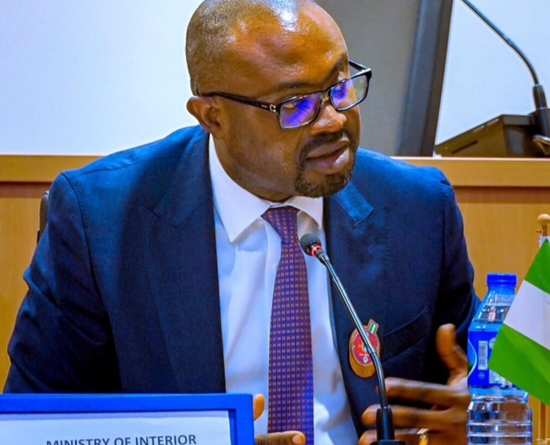
The Minister of Interior, Dr Olubunmi Tunji-Ojo, made the disclosure on Wednesday in Abuja at the Regional Conference on the Classification of Prisoners and the Use of Technology in Prisons in Africa.
The conference was jointly organised by the United Nations Office on Drugs and Crime (UNODC) and the African Correctional Services Association (ACSA).
Tunji-Ojo said the figures had exposed the need for a fundamental rethink of the way Nigeria and other African countries classify offenders and deploy imprisonment as a response to crime.
“93% of our inmates in Nigeria are state offenders. Only 7% are federal offenders. And of this 93%, I want to tell you before this president came on board, a lot of them were for minor offences that had no need for incarceration,” the minister said.
He said the Federal Government, upon his assumption of office, undertook an audit of inmates incarcerated over minor fines and compensation orders, a process that resulted in the release of more than 4,000 inmates.
“When I became minister, I called my permanent secretary, I called the Controller General of the Correctional Service, and I said, listen, give me the data, the record of people who are in correctional centres for fines and compensation of less than 500,000 or something. And guess what? Over 4,000 people,” he said.
According to the minister, the continued detention of such inmates was economically irrational, as the government spent far more feeding and maintaining them than the value of the fines or compensation involved.
“I said, what is the sense in this? Because I feed them in a year with more than 10 times of the fine. So how is the government benefiting?” he asked.
Tunji-Ojo said the government subsequently cleared the affected cases, resulting in the decongestion of correctional facilities by five per cent in a single day.
“And we were able to clear that, and in one day, we decongested our correctional centre by 5% in one day. In one day,” he said.
The minister said the experience raised a broader question about the rationale behind overcrowding in correctional facilities, insisting that the number of inmates alone should not be the only measure of the crisis.
“The question is this. Is your correctional centre rightfully overcrowded? That is the question. You have to look at those particular offences. You will realise that more than 30, 40, 50 percent are offences that do not warrant incarceration,” he said.
The disclosure comes against the background of Nigeria’s long-running prison congestion crisis. Correctional facilities across the country have for years struggled with overcrowding, placing enormous pressure on feeding, healthcare, security, rehabilitation and other essential services.
A significant proportion of the inmate population comprises persons awaiting trial. In many cases, detainees spend prolonged periods in custody before their cases are concluded, with some eventually discharged for lack of evidence or after spending periods in detention that exceed the sentences they might have received if convicted.
The situation has fuelled concerns over access to justice, the presumption of innocence and the impact of poverty on the criminal justice system, particularly where suspects are unable to meet bail conditions or secure effective legal representation.
The minister’s position suggests that the problem cannot be solved simply by constructing more prisons. Rather, it requires a more rigorous classification of inmates, faster trials and greater use of non-custodial measures for minor and non-violent offences.
Beyond decongestion, Tunji-Ojo said the Federal Government had also recorded significant progress in reducing recidivism through education, skills acquisition and rehabilitation.
He disclosed that the number of inmates returning to crime had fallen sharply from about 13,000 cases annually in 2023 to approximately 1,000 last year.
The minister attributed the improvement to increased access to education and vocational training within correctional facilities.
He said 62 inmates were currently pursuing postgraduate studies, while 261 were enrolled in undergraduate programmes. Another 1,125 inmates were participating in formal education.
He further disclosed that 18 National Open University of Nigeria centres had been established within correctional facilities, while 9,582 inmates were enrolled in vocational and non-formal rehabilitation programmes.
The figures, he said, reflected a deliberate shift in the philosophy of corrections from mere confinement to rehabilitation and reintegration.
Tunji-Ojo also said Nigeria had gone three consecutive years without recording a jailbreak or an attack on a correctional facility, attributing the achievement partly to improved data management and information sharing among security agencies.
He cited the case of an escaped inmate who was rearrested after attempting to obtain a Nigerian passport.
According to him, the inmate’s biometric information triggered an alert when he approached the Nigeria Immigration Service.
“Immediately he put his finger at the level of Nigeria Immigration Service to procure a passport. Immigration saw it immediately that he was an inmate. And immediately they reached out to Correctional Service and he was arrested right there,” the minister said.
He said the incident demonstrated the importance of integrating technology and biometric data across government agencies in strengthening national security and improving correctional administration.
The Controller-General of the Nigerian Correctional Service, Sylvester Nwakuche, said the country had continued to modernise its correctional system through reforms anchored on the Nigerian Correctional Service Act, 2019.
Nwakuche said the classification of inmates had become a strategic instrument for identifying risks, protecting vulnerable prisoners, deploying resources efficiently and delivering rehabilitation programmes tailored to the needs of individual inmates.
He said the proper classification of prisoners was essential to ensuring that inmates were not managed as a homogenous group, stressing that the risks, needs and rehabilitation requirements of a convicted violent offender could not be treated in the same manner as those of a low-risk or vulnerable inmate.
The Controller-General also said the integration of technology into correctional administration would improve record management, strengthen information sharing and enhance institutional accountability.
He noted that correctional institutions across Africa faced complex security and rehabilitation challenges that could not be solved by any single institution acting alone.
“No single correctional service possesses all the solutions to today’s security and rehabilitation challenges,” Nwakuche said.
He added: “We have a unique opportunity to exchange ideas, share practical experiences and collectively develop solutions that will strengthen correctional systems across Africa.”
The Abuja conference therefore provided a platform for African correctional authorities and international partners to examine how prisoner classification and technology could be deployed to improve prison management, enhance security and promote rehabilitation.
For Nigeria, the discussions are particularly significant as the country continues to confront the challenge of overcrowded custodial centres and a criminal justice system in which many suspects remain in detention for extended periods before trial.
The latest figures have also brought renewed attention to the relationship between federal and state justice systems. Although the Nigerian Correctional Service is a federal institution, the minister said 93 per cent of inmates were being held for state offences.
This means that the Federal Government is responsible for the custody, feeding, healthcare and rehabilitation of a large population of inmates whose alleged offences fall under state jurisdiction.
The revelation is likely to intensify calls for states to take greater responsibility for the administration of criminal justice, particularly by strengthening their courts, improving prosecution, expanding legal aid and ensuring that minor offenders are not unnecessarily committed to custodial facilities.
Legal and human rights advocates have long argued that the nation’s prison congestion crisis is not simply a problem of inadequate infrastructure. They maintain that unnecessary arrests, prolonged investigations, delayed trials, inability to meet bail conditions and the overuse of imprisonment for minor offences are major drivers of overcrowding.
The Federal Government’s experience of releasing more than 4,000 inmates in a single day over fines and compensation orders of less than about N500,000 has now provided a stark illustration of the problem.The development also highlights the economic cost of unnecessary incarceration.
As Tunji-Ojo pointed out, the cost of feeding and maintaining an inmate for a year could be many times higher than the fine or compensation that led to the person’s imprisonment in the first place.
The challenge before Nigeria, therefore, is to ensure that imprisonment is used for offenders whose incarceration is necessary to protect society, while non-custodial alternatives are deployed for minor offences and low-risk offenders.
The minister’s disclosure has consequently transformed the debate over prison congestion from a question of how many more custodial facilities Nigeria needs to a more fundamental question: how many people should be in prison in the first place?
With 93 per cent of inmates reportedly held for state offences, between 30 and 50 per cent allegedly serving sentences for offences that may not warrant incarceration, more than 4,000 inmates freed in one day and recidivism reportedly falling from about 13,000 to 1,000 cases annually, the Federal Government says the future of Nigeria’s correctional system must lie in smarter classification, technology-driven administration, rehabilitation and a justice system that reserves imprisonment for those who truly need to be behind bars.