

This Mysterious Mushroom Makes People See Hundreds Of Tiny Humans — Its History Goes Back Centuries
NewsNowOnline | Science and Nature
A mysterious mushroom linked to visions of hundreds of tiny, human-like figures has attracted renewed scientific attention, with researchers still searching for the chemical responsible for its unusual effects.
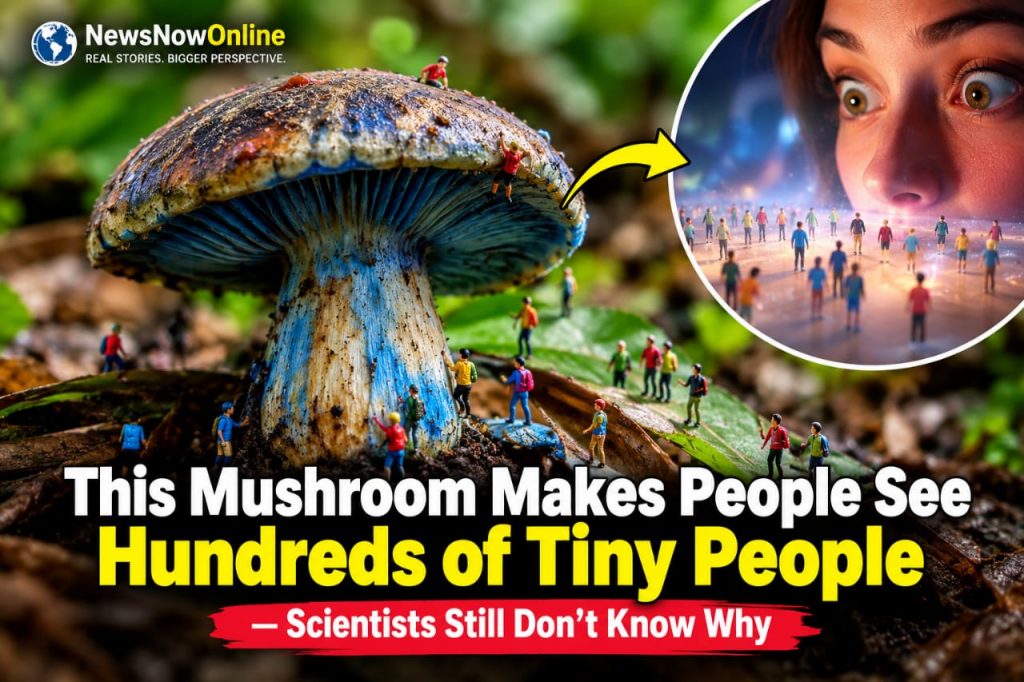
Known scientifically as Lanmaoa asiatica, the mushroom is associated with parts of Asia, particularly Yunnan Province in southwestern China. People who experience its effects have described miniature figures walking across tables, climbing walls, and moving around everyday objects. Scientists call this phenomenon Lilliputian hallucination.
But the mystery may be much older than its scientific name.
A Mystery With a Long History
Historical accounts suggest that similar experiences may have been described centuries ago. A third-century Daoist text reportedly refers to a “flesh spirit mushroom” associated with seeing a little person. However, scientists have not established that this ancient reference describes Lanmaoa asiatica.
In 1934, reports from Papua New Guinea described unusual behavioural and perceptual effects associated with a wild mushroom known as nonda. Subsequent investigations during the 1950s and 1960s failed to identify the precise species or establish the chemical responsible.
Interest resurfaced in China, where a 1991 scientific report documented mushroom-related cases involving miniature-human hallucinations.
A significant development came in 2015, when Lanmaoa asiatica was formally described as a distinct mushroom species. Its identification gave researchers a clearer starting point, although it did not solve the mystery of its effects.
Further clues emerged from the Philippines in 2024. Researchers investigating a mushroom known locally as sedesdem, associated with visions of tiny beings called ansisit, used DNA analysis to link their specimens to Lanmaoa asiatica. This provided a stronger biological connection between reports from the Philippines and China.
Why Does It Make People See Tiny People?
Unlike conventional psychedelic mushrooms, which may contain the compound psilocybin, Lanmaoa asiatica appears to produce a distinctive type of hallucination.
Scientists have not conclusively identified the substance responsible. Genetic investigations have also made the familiar explanations involving psilocybin and certain other known mushroom toxins less straightforward.
Researchers still need to determine which chemical causes the visions, how it affects the brain and whether it explains all the reported cases.
The historical accounts from Papua New Guinea are particularly intriguing, but the mushroom involved there has not been conclusively identified as the same species.
Is It Safe to Eat?
The mushroom is consumed as food in parts of China, but inadequately cooked specimens have been associated with hallucinations and other adverse effects.
Traditional consumption does not mean that it is safe to eat raw or undercooked. People should not experiment with wild mushrooms to experience hallucinations. Anyone who develops hallucinations, confusion or other concerning symptoms after eating a wild mushroom should seek urgent medical attention.
What Scientists Still Need to Discover
The most important unanswered question is the identity of the compound responsible for the visions. Discovering it could help researchers better understand unusual visual experiences and the effects of fungi on the human brain.
For now, Lanmaoa asiatica remains a remarkable scientific mystery: a mushroom with a formal scientific identity, reports spanning different cultures and historical periods, and an effect that researchers have yet to fully explain.
NewsNowOnline takeaway:
The mushroom’s scientific identification dates to 2015, but reports of similar experiences may be far older. The connection between ancient accounts and the modern species remains unproven, and the chemical responsible for the tiny-human hallucinations is still unknown.
Sources for further reading
– “ScienceDaily — Research on the mysterious mushroom” (https://www.sciencedaily.com/releases/2026/10/261024222021.htm)
– “Live Science — The fungus linked to tiny-human hallucinations” (https://www.livescience.com/chemistry/it-sounds-so-impossible-student-studying-fungus-that-makes-users-hallucinate-tiny-people-may-be-on-the-verge-of-a-scientific-breakthrough)
– “Discover Wildlife — Background on Lanmaoa asiatica” (https://www.discoverwildlife.com/plant-facts/fungi/lanmaoa-asiatica-mushroom)
Editorial note: Historical similarities do not prove that every account involved the same species. The responsible chemical has not been conclusively identified.
culled from University of Utah Research publication