China Hands Over Landmark ECOWAS Headquarters In Abuja, As Leaders Call For Stronger West African Unity
By Bukar BOLORI
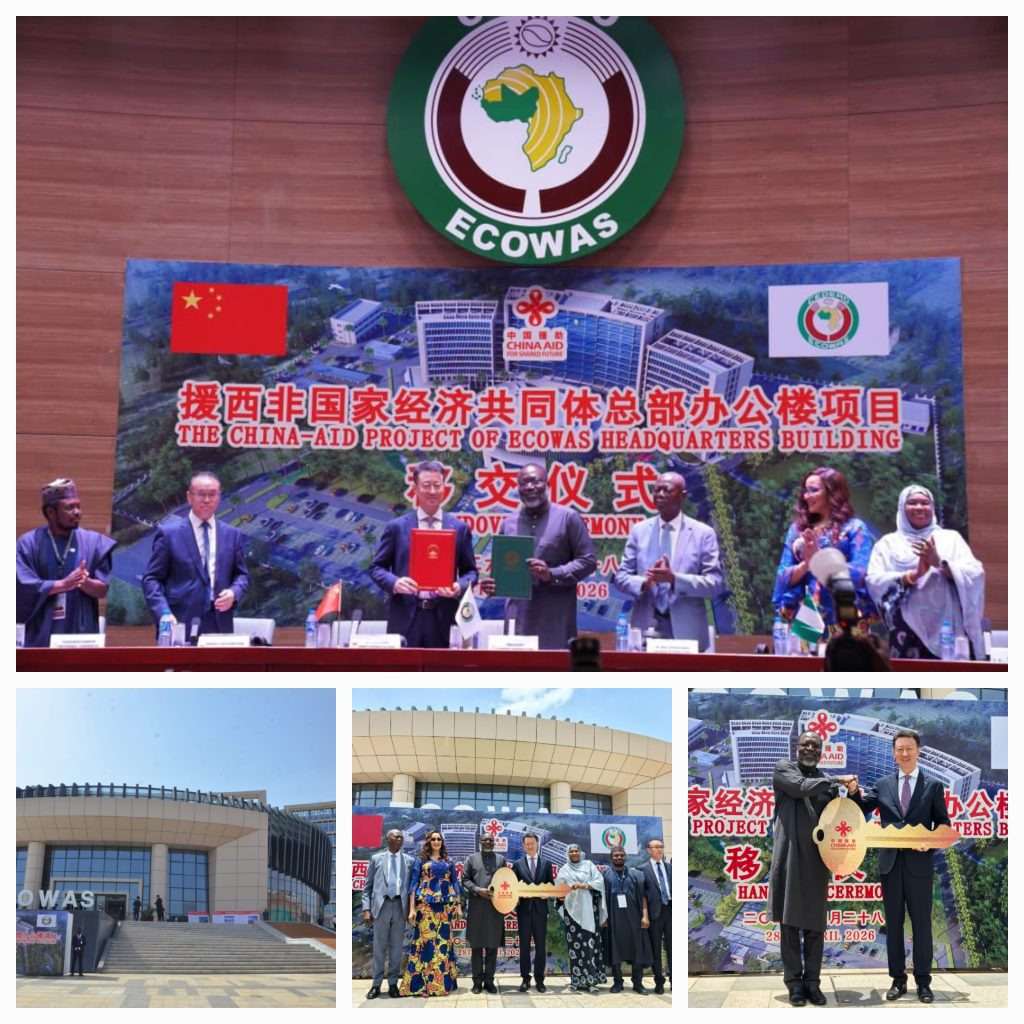
The Government of China on Tuesday officially handed over the newly constructed headquarters complex of the Economic Community of West African States in Abuja, in a ceremony marked by strong appeals for unity, deeper integration, and renewed commitment to regional cooperation across West Africa.
The event brought together senior government officials, diplomats, and regional leaders, with speakers consistently framing the project as more than infrastructure—describing it as a strategic symbol of partnership, vision, and collective ambition for the sub-region.
President of the ECOWAS Commission, Omar Alieu Touray, described the occasion as a historic milestone, noting that it coincides with the bloc’s 50th anniversary.
“Today marks an important day for ECOWAS and we should all be glad to be witnesses to this momentous occasion marking the official handover of the New ECOWAS Headquarters Complex to the Commission,” he said, adding that the development comes at an opportune time in the organisation’s integration journey.
Touray clarified that the ceremony represents the completion and handover of the building, while the formal inauguration will take place later in the year.
The commissioning is expected to be led by Sierra Leone’s President, Julius Maada Bio, in his capacity as Chairman of the ECOWAS Authority, alongside Nigeria’s President, Bola Ahmed Tinubu, and other heads of state.
Reflecting on the project’s origins, he recalled that the groundbreaking took place in October 2023 with funding support from China amounting to approximately $56.57 million.
“As you may recall, back in October 2023, we convened here for the groundbreaking ceremony of this complex… Today, two years after that initiation, we are gathered for the handover ceremony of this remarkable building,” he said.
Touray commended the speed and quality of delivery, noting: “Considering the time usually taken to complete infrastructure projects of this magnitude and complexity, the completion of this ECOWAS Headquarters Complex within two years is highly commendable and we should all applaud our Chinese brothers and sisters.”
He also extended appreciation to Chinese President Xi Jinping, represented by Ambassador Yu Dunhai, for what he described as a generous contribution to regional development, while acknowledging China’s broader support for ECOWAS peace and security operations, including assistance to the ECOWAS Standby Force.
Touray further thanked Nigerian authorities, including the FCT Minister Nyesom Wike, for their support in facilitating the successful execution of the project.
Chinese Ambassador Yu Dunhai, in his remarks, described the headquarters as a flagship project and a symbol of enduring China-Africa cooperation.
“This headquarter building stands as a milestone—it is China’s flagship aid project for ECOWAS and another headquarters for an international organization,” he said, comparing it to other major Chinese-supported institutional projects on the continent.
Affectionately called the “Eye of West Africa,” the ambassador said the structure was completed after “more than 1,200 days and nights of meticulous craftsmanship,” blending Chinese engineering expertise with West African cultural identity.
“The building harmonizes the excellence of Chinese architectural technique with the unique culture of West Africa,” he said, adding that it will strengthen ECOWAS’ operational capacity and serve as a platform for regional development.
Yu also situated the project within broader diplomatic context, noting that this year marks 70 years of China-Africa relations.
He said China continues to support African modernization through initiatives such as the “Ten Partnership Actions,” expanded South-South cooperation frameworks, and zero-tariff access for African exports.
“We remain committed to a demand-driven approach that respects African autonomy and sovereignty, translating our support into tangible actions for Africa’s revitalization,” he said.
He reaffirmed China’s support for ECOWAS and praised its role in regional peace and integration, while also acknowledging Nigeria’s leadership in the partnership.
For Nigeria, the host nation, the project carries deep symbolic weight.
Minister of the Federal Capital Territory, Nyesom Wike, said the occasion represented far more than a physical handover.
“Today is not just about the handover of a building. Today marks the handover of a vision. A vision of partnership. A vision of regional solidarity. A vision of a West Africa that is prepared to build the institutions that will carry its future,” he said.
Wike described the headquarters as “more than concrete, steel, and glass,” calling it “a statement that cooperation still matters” and proof that diplomacy can still deliver tangible results.
He emphasized Abuja’s status as a diplomatic hub, noting: “Abuja is not only the seat of government; Abuja is the diplomatic capital of this nation, a meeting point of nations.”
He added: “Great institutions deserve worthy homes,” describing ECOWAS as a key expression of regional identity and hope.
Minister of State for Foreign Affairs, Bianca Odumegwu-Ojukwu, also framed the handover as a historic and symbolic moment.
“It is with profound honour and a deep sense of history that I stand before you today,” she said, describing the event as more than the commissioning of a building, but “the consolidation of a vision, a reaffirmation of unity, and a renewed commitment to peace and sustainable development.”
She highlighted ECOWAS’ role since 1975 in conflict prevention, peacekeeping, economic integration, and governance, stressing that the new headquarters would enhance institutional efficiency and coordination.
“This new Headquarters therefore symbolizes more than administrative convenience. It is a strategic asset that will enhance institutional effectiveness… and reinforce the capacity of the Commission to respond to emerging regional and global challenges,” she said.
Odumegwu-Ojukwu praised President Tinubu’s leadership in advancing regional integration and commended China for what she called a “remarkable gesture of goodwill,” adding that the project reflects “mutual respect, shared prosperity, and South-South cooperation.”
She also issued a strong call to member states:“At a time when our region is confronted with complex challenges… our unity is not optional, it is imperative. We must continue to act in concert, speak with one voice.”
Across all speeches, a consistent message emerged: while the new headquarters represents a major infrastructural achievement, its true value will depend on the political unity and collective resolve of West African states.
As the ceremony concluded, leaders underscored that the building is not an end in itself, but a platform for the next phase of regional integration—one defined not by construction, but by cooperation.