By BENJAMIN OMOIKE LAGOS, Nigeria – Germany has announced plans to accelerate the digitalisation of its visa process to ease travel for business, cultural and economic exchanges with Nigeria, as it seeks to deepen trade, investment and diplomatic ties with Africa’s largest economy.
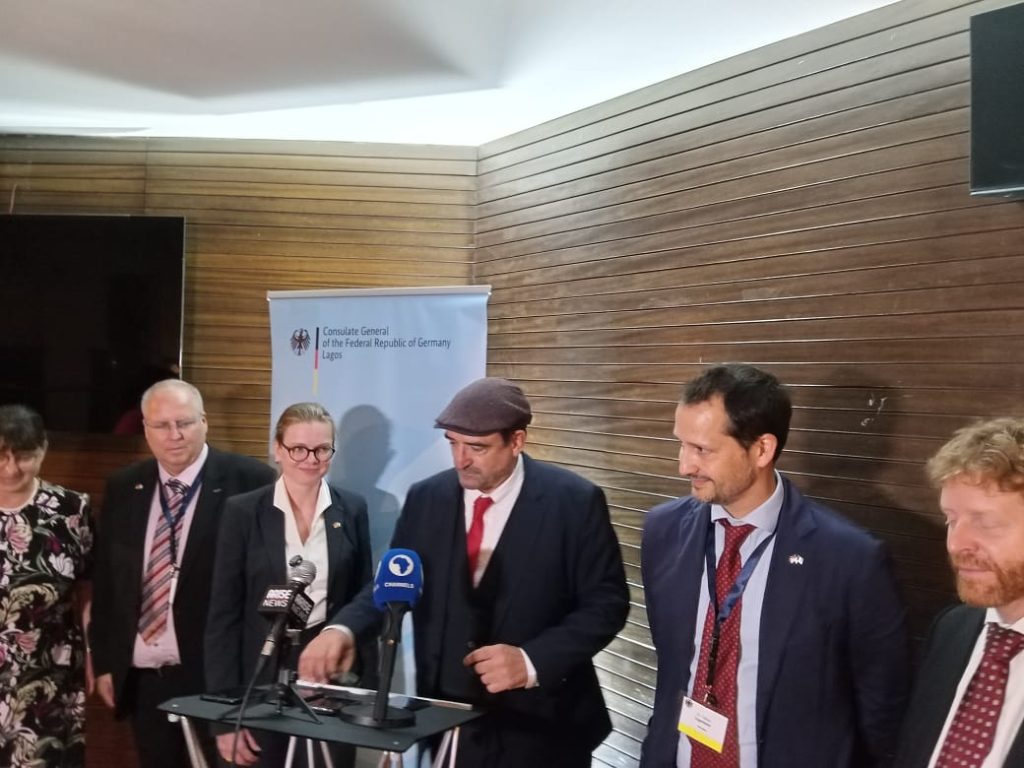
German Minister of Foreign Affairs, Johann Wadephul, disclosed this during a high-level political and business engagement in Lagos on Tuesday, where he described Nigeria as a strategic partner in Germany’s long-term engagement with Africa.
According to him, cultural exchanges between both countries have been largely underestimated and deserve greater attention alongside economic cooperation.
“We need to do much more in this area, and that is why, alongside the economic aspect, I always try to emphasise the cultural dimension during my travels,” Wadephul said.
“That is why I frequently visit the Goethe-Institute and the German Archaeological Institute, and today I am here with influencers in the metropolis of Lagos.”
Responding to calls for easier visa access to support business and cultural engagements, the minister said Germany was becoming more flexible by modernising its visa administration.
“I believe Germany needs to be more open to this sort of thing. We need to be more flexible in this regard. That is why we at the Federal Foreign Office are also pushing ahead with the digitalisation of the visa process,” he said.
He, however, stressed that broader reforms were still required.
“But the Federal Government as a whole needs to step up its efforts in this area. We thrive on exchange. We are, by tradition, an exporting nation, and exporting nations must always remain open to outside influences. That is why we should continue to work on our openness and our flexibility.”
Wadephul described Africa as one of the world’s fastest-growing economic regions, saying Nigeria occupies a pivotal place in Germany’s Africa strategy as the country’s second-largest trading partner in Sub-Saharan Africa and the continent’s largest domestic market.
“Africa is a continent of opportunities for Europe,” he said.
“The continent is young, innovative and keen to consume. This offers great opportunities for German companies, particularly in Nigeria.”
He noted that German exports to Nigeria already span machinery, chemical products and foodstuffs, while cooperation has expanded into energy, climate initiatives and raw materials.
The minister said Nigeria has become increasingly important to Europe’s energy security, revealing that about 25 per cent of Europe’s kerosene supplies in June originated from Nigeria.
“We are already working closely together in the fields of energy, climate and raw materials extraction, for example through our energy partnership,” he said, noting that Germany is supporting projects aimed at reducing gas flaring in Nigeria.
Describing the conflict around the Strait of Hormuz as a reminder of the need to diversify energy sources, Wadephul said Germany was looking beyond traditional energy cooperation to renewable energy, critical minerals and rare earths.
“We need new sources of supply. We need new ways of securing these resources, and that is why I believe the African continent—and Nigeria in particular—is of crucial importance,” he said.
He added that Germany was also seeking to reduce its dependence on China for critical minerals by expanding partnerships with countries such as Nigeria.Beyond energy, Wadephul identified Nigeria’s thriving technology ecosystem as one of the country’s greatest untapped opportunities for German investors.
He said Nigeria’s IT and start-up ecosystem had enormous potential that Germany had yet to fully recognise or exploit, warning that companies that fail to establish a presence in Africa risk missing significant future opportunities.
“I want to see our trade and investment relations with Nigeria expanded,” he said, adding that German companies are globally recognised for their reliability and “Quality Made in Germany.”
Calling on German businesses to increase their presence in Nigeria, Wadephul said his ministry would work more closely with business leaders to identify investment opportunities and help address regulatory and bureaucratic bottlenecks.
“I would like to remain focused and discuss with business leaders what they are planning in individual countries and then follow this up together with the Ministry for Economic Affairs,” he said.
According to him, Germany intends to maintain sustained engagement with Nigeria rather than relying on one-off diplomatic visits.
“This will certainly not be my last visit here,” he said, adding that he would also meet with the President of the ECOWAS Commission as part of Germany’s broader engagement with West Africa.
“Africa is a continent of opportunities for Europe. But opportunities must be seized, and that cannot be achieved with a one-off visit. It requires a long-term commitment from the entire Federal Government and from the business community as a whole.”
Also speaking at the event, Stefan von der Mark, co-founder and Managing Director of German technology company Fiebersteine, underscored the importance of sustained investment in infrastructure to support Nigeria’s long-term economic development.
He said Nigeria presents enormous opportunities owing to its rapidly expanding industrial base and growing economy.
“I think there’s a lot of opportunities for the future to have very fruitful collaborations,” he said.
Von der Mark added that stable and reliable government-to-government relations were essential because infrastructure projects often require years of implementation.
Similarly, Tobias Engelmeier, Chief Executive Officer of VIDA.place, a map-based artificial intelligence company working with infrastructure investors, described Nigeria as one of the company’s most important markets.
He said the company is already partnering with Nigeria’s Rural Electrification Agency to support its goal of providing electricity access to about 80 million Nigerians who currently lack modern energy.
“For that, you need to know where people are who don’t have energy access, where the current grid is, and then think about how to best approach them,” Engelmeier said.
Describing Nigeria as a dynamic and exciting market, he said the company had enjoyed a successful partnership with Nigerian institutions and praised the quality of Nigerian technology professionals working within its global operations.
“We really appreciate and enjoy working with Nigerians on our technology. We also have Nigerians in our team who are some of the smartest people I’ve come across, and they help us build our global technology. It’s really nice to be in Lagos, Nigeria,” he said.