Wike Urges EU Countries To Partner With FCT On Investments, Cultural Exchange, Others
Minister of the Federal Capital Territory (FCT), Nyesom Wike, has called on European Union (EU) countries to deepen investment ties, strengthen cultural exchanges, and partner with the Federal Capital Territory Administration (FCTA) in areas of mutual interest to build a prosperous Abuja and Nigeria.
Wike, while addressing EU Heads of Mission during a meeting at the European Union House in Abuja on Tuesday, said he will continue to look forward to a continued collaboration and engagement with the EU countries to foster development of the FCT.
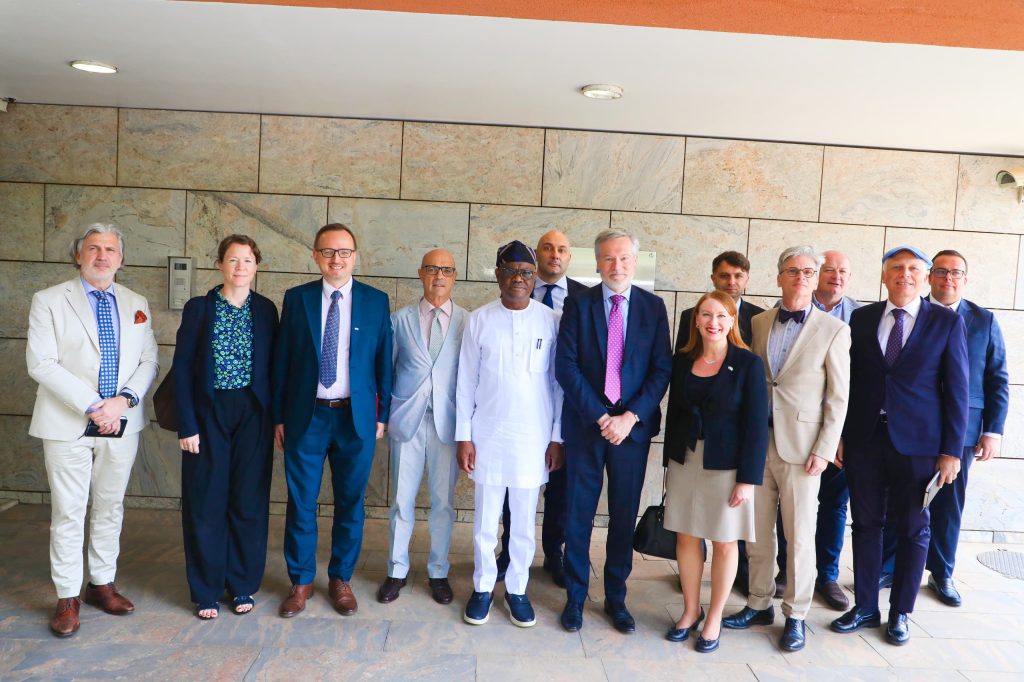
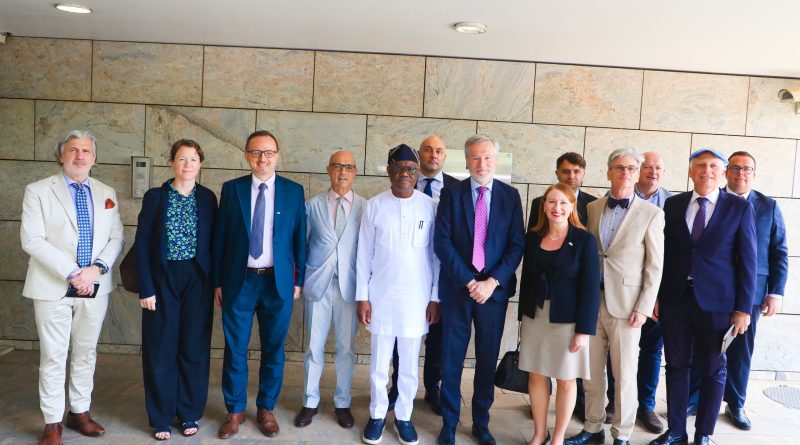
The meeting, which was chaired by the Head of the European Union Delegation to Nigeria and to the Economic Community of West African States (ECOWAS), Ambassador Gautier Mignot, had in attendance Envoys of Italy, Austria, Ireland, France, Hungary, Germany, Poland, Romania, Bulgaria, Greece, Finland, Belgium, Sweden, Spain, Czech Republic and Denmark.
Ambassador Gautier Mignot, who set the tone for the meeting while introducing the Minister, described the EU as Nigeria’s first trade and investment partner.
Addressing the EU Heads of Mission, the Minister spoke about the FCTA priorities as a government, investment opportunities in the FCT, and the political landscape of Nigeria.
He also noted FCT’s position as a business-friendly capital city, listing investment opportunities to include real estate and housing, entertainment and tourism, agriculture, solid minerals, waste management, among others.
“I thank the European Union Delegation to Nigeria for the invitation and continued partnership with the Nigerian Government in advancing shared values of development, stability, and prosperity.
“Today, drawing from the Renewed Hope Agenda of Mr. President, His Excellency Bola Ahmed Tinubu, GCFR, I will briefly highlight the priority areas of the Federal Capital Territory Administration (FCTA), the investment opportunities therein, and offer an overview on Nigeria’s evolvingpolitical landscape,” Wike said.
He noted that the government has prioritized urban/rural development and infrastructure, security, education, health, social welfare, land administration reforms/revenue generation and rule of law.
“We have embarked on a deliberate and sustained investment in infrastructure as a catalyst for economic growth and social inclusion by expanding road networks, modernizing public transport and improving water supply.
“As a priority too, the administration has strengthened security infrastructure through the building of 12 new fully equipped/furnished Divisional Police Headquarters and Officers’ Quarters, (2 each in the 6 Area Councils).”
Wike, who fielded questions from the ambassadors, described the amended Electoral Law as part of governance reforms to further guarantee the integrity and credibility of electoral processes, while also saying growing reliance on legal, institutional and constitutional mechanisms to resolve political disputes by aggrieved parties rather than resorting to self-help and violence was a reflection of greater trust in judicial processes and maturing democratic culture.
“In the newly ammended Electoral Act, there is provision for electronic transmission of results. But because of our peculiarities, it was included that where electronic transmission fails, manual transmission can be used. Meanwhile, there is no such provision in the 2022 ammended Electoral Act,” he said.
Wike also said in a country like Nigeria, where democracy is evolving, opposition should not be seen as an avenue to cause or promote crises, but to provide alternative and guide government.
The Minister said, under President Bola Ahmed Tinubu, Nigeria’s political trajectory was increasingly evolving towards a governance-focused paradigm where competence is increasingly prioritized over ethnic, partisan and religious considerations.
“Compared to earlier periods, there is a decline in highly volatile and rancorous politicking that characterized the relationship between the Executive and the Legislature. The relationship between these two key institutions have become that of ‘partners-in-progress’ in the making and implementation of policies and programmes for the welfare of Nigerians,” Wike said, while highlighting the importance of cordial relationship between the Executive and the Legislative arms of government.
On the policy direction of the President Tinubu’s administration, which the Minister said is anchored on bold and difficult reforms, he explained that; “The Current Administration in its Renewed Hope Agenda framework, has made bold and at times, difficult reforms aimed at repositioning the economy and improving citizens’ welfare.
“These include; Economic Reforms and Fiscal Restructuring/Discipline, which ensured Subsidy Removal to eliminating a long-standing but corruption-prone system and free up public funds, unification of foreign exchange rates to stabilize the currency and tax reforms aimed at Streamlining the Tax System to improve revenue generation.
“Expansion of Social and Welfare Interventions with initiatives like the conditional cash tranfster and support for Small and Medium Enterprises to cushion the effect of difficult economic reforms on vulnerable populations and student loan tailored towards giving the Children and Wards of the poor, access to education even at the tertiary education levels.”
He admitted that there are security challenges like the presence of internationally backed terrorist groups in the Sahel, translating into insurgency, farmer-herder conflict, banditry and kidnapping.
The Minister, however, emphasized that there are ongoing and sustained efforts to address insurgency, banditry, kidnapping, and communal conflicts, which he said has continued to shape policy decisions and political narratives.
Wike also said that sustained efforts are being made to strengthen security architecture, enhance inter-agency coordination and invest in intelligence gathering and technology.